
Sterilisation traceability in a dental practice, explained simply
What sterilisation traceability means in practice, from the autoclave cycle to the patient the kit was used on, and how to keep records without lost paperwork.
Sterilisation is one of the most important activities in a dental practice and, at the same time, one of the least visible. The patient sees the kit being opened in front of them, but not the autoclave cycle, the tests or the log where everything was recorded.
That is exactly why traceability matters: being able to reconstruct, at any time, an instrument’s path from sterilisation to the patient. Below we explain what this means in practice and how to organise a routine that does not depend on one person’s memory.
What traceability means, in plain terms
Traceability means that for every kit used you can answer a few simple questions:
- Which sterilisation cycle was it processed in?
- Did the cycle finish correctly, and were the test results good?
- Who carried out the sterilisation, and when?
- Until when is the sterilisation valid?
- Which patient was it used on?
If the answer to any of these questions is “we don’t know” or “we’ll have to look through the notebooks”, the chain has a weak link. And a weak link shows up exactly when you need it: during an inspection, after a complaint, or when a test fails and you have to find out which kits are affected.
The four elements of complete records
1. Cycle records
Every autoclave cycle is recorded: the date, the machine, the programme used, who started it and the result. Many modern machines print or save the cycle parameters; this information is worth keeping together with the rest of the records, not separately in a drawer.
2. Tests
Tests confirm that the machine and the cycle worked as they should. In dental practice, several types are usually used:
- the Bowie-Dick test, which checks air removal and steam penetration in the autoclave, usually done at the start of the day;
- chemical indicators on pouches or inside packs;
- biological indicators, at the recommended intervals.
How often each test is done and how the results are kept are set by the rules in force and by the machine manufacturer’s instructions; these are what must be followed.
3. Labelling
Every sterilised pouch or kit gets a label with the essential information: the cycle, the sterilisation date, the date until which it is valid and, if you wish, the person who prepared it. A handwritten label can be hard to read or can rub off; a printed label is safer.
4. The link between kit and patient
This is the step most often skipped. The kit is opened, used and sent back for reprocessing, but nobody records which patient it was used on. Without this link, if a cycle later turns out to be non-compliant, there is no way to find out which patients were treated with instruments from that cycle.
Where the chain usually breaks
In many practices the records exist, but they are scattered: a notebook for cycles, a folder of test results, handwritten labels and, sometimes, nothing in the patient’s chart. Problems appear in a few predictable places:
- The morning rush. The morning test is done, but the result is not recorded straight away.
- Out-of-date kits. A pouch left at the back of a drawer goes past its expiry date and ends up on the work tray by mistake.
- A failed test. If a test fails, the kits from that cycle should be withdrawn. On paper, that means finding them one by one.
- The link to the patient. Recording the kit in the chart is one more task for the nurse in the middle of treatment, so it gets forgotten.
A recommended daily routine
A good routine is one the team can keep to even on a busy day. A simple model:
- In the morning: the autoclave function test, with the result recorded straight away.
- For every cycle: the cycle is recorded, and the packs get a label with the cycle and the expiry date.
- In storage: kits are arranged so that those with the nearest expiry date are used first.
- With the patient: before opening the kit, the label is checked and the kit is linked to the patient.
- Weekly: a check of the stored kits for those nearing their expiry date.
Who is responsible for what
The routine only works if every step has someone responsible for it. In many practices, one nurse handles sterilisation on a given day or shift, and her name appears in the records. When someone else takes over, the handover is explicit: which cycles are running, which kits are waiting, which tests still need to be done. It is worth having new team members learn the routine from the start, not on the job, and keeping the written procedure on display in the sterilisation room.
The key is for each step to take as little time as possible. Any record that takes more than a few seconds risks being put off.
How Stomatik helps with sterilisation traceability
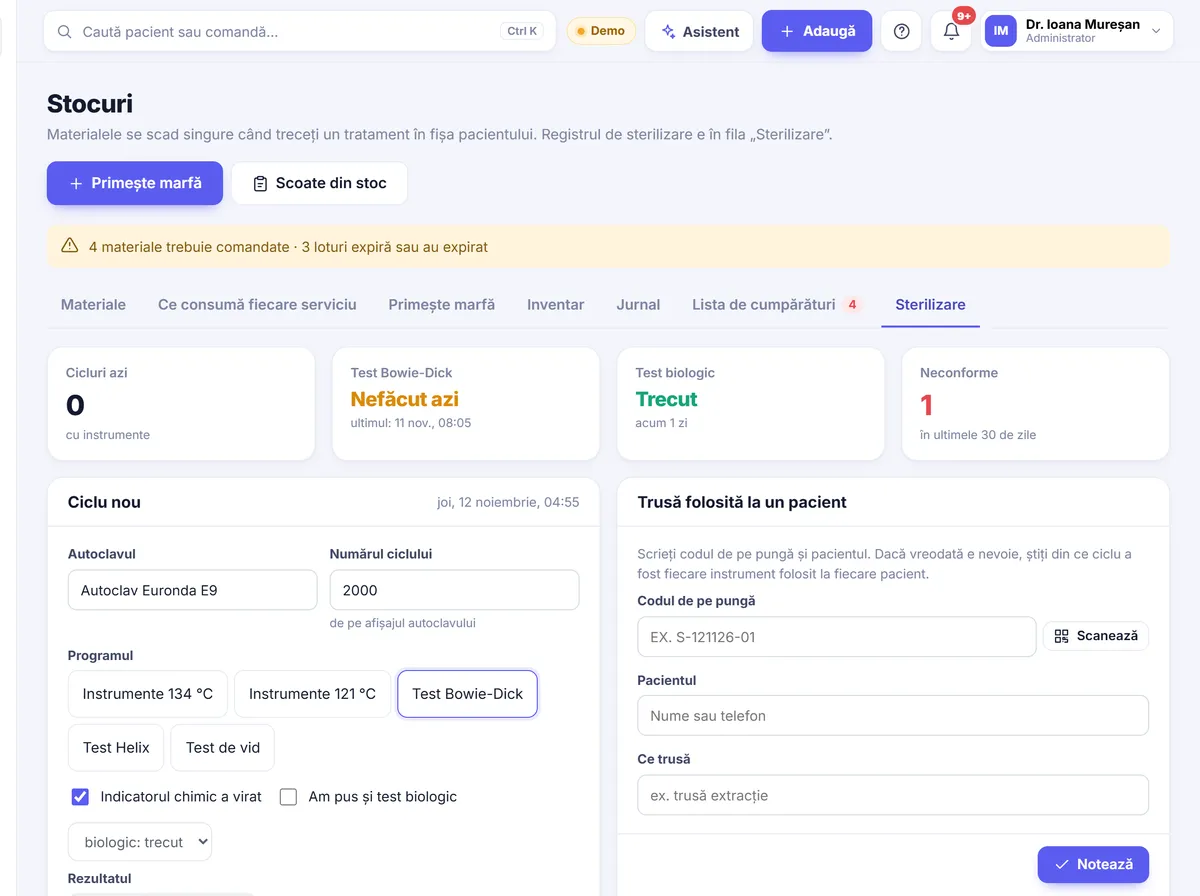
In Stomatik, sterilisation has its own module, designed to bring all the steps above together in one place.
Autoclave cycles and tests
Autoclave cycles are recorded in the app, together with the tests, including the Bowie-Dick test. The records are no longer kept in separate notebooks but in one place, where they can be checked at any time.
Labels with a QR code
Sterilised kits get labels with a QR code. The label carries the link to the cycle in which the kit was processed.
Kit to patient, with one scan
With the patient, the nurse scans the QR code on the kit, and the kit is linked to that patient. The program runs in the browser, on a computer, tablet or phone, so the scan is done with a device already in the surgery. The link between kit and patient, the step most often skipped on paper, becomes a matter of a few seconds.
Kits blocked automatically
The app blocks the use of a kit if the test for its cycle failed or if its expiry date has passed. The check no longer depends on someone’s attention at the end of a long day.
Because the records live in the same program as the patient chart, sterilisation is no longer kept separately from the rest of the practice’s work. Access can be limited for each member of the team, and the app keeps an Activity log; you will find details on data protection on the security and GDPR page.
In short
Sterilisation traceability does not mean extra bureaucracy, but a complete chain: cycle, test, label, patient. When every link is recorded simply and straight away, the practice can calmly answer any question about a kit. The program’s features are the same in every plan; you can compare the plans on the pricing page.
Try sterilisation records with QR labels and kits linked to patients in your own practice.
Frequently asked questions
What does sterilisation traceability mean?
It means that for every kit used you can find out which cycle it was sterilised in, whether the tests were good, until when it is valid and which patient it was used on.
What is the Bowie-Dick test?
It is a test that checks air removal and steam penetration in the autoclave. It is usually done at the start of the day, in line with the rules in force and the manufacturer’s instructions.
How long must sterilisation records be kept?
How long and in what form they are kept is set by the rules in force in Romania. We recommend checking with the competent public-health authority or with a consultant.
How do I link a kit to a patient in Stomatik?
The kit has a label with a QR code, and the nurse scans it with the patient. The kit then stays linked to that patient.
What happens if a sterilisation test fails?
Stomatik blocks the use of kits from the cycle whose test failed, just as it does for kits past their expiry date.