
Stock management in a dental practice: no shortages, no expired materials
Why materials run out exactly when you need them, why others expire on the shelf, and the simple routines that keep your practice’s stock under control.
Almost every dental practice has been there at least once: the patient is in the chair, the anaesthetic has been given, and the nurse discovers that the last tube of composite in the right shade ran out yesterday. Or the opposite: while clearing out the cupboards, three boxes of material turn up that expired months ago, paid for and forgotten.
Both situations have the same cause: stock is kept “in someone’s head”, by a single person, with no clear routine. The good news is that good stock management in a dental practice does not need a warehouse or a dedicated stock manager. It needs a few simple rules, applied consistently.
Why materials run out or expire
Before looking at solutions, it is worth understanding the causes. The most common ones are:
- Nobody is responsible. Everyone takes from the cupboard, nobody writes anything down. The shortage is only noticed when the shelf is empty.
- Orders are placed “when someone remembers”. Without a set threshold, the order goes out too late or, out of caution, too large.
- New material goes at the front. Freshly delivered boxes end up within easy reach, while the older ones stay at the back until they expire.
- Supplier offers. A large promotional pack looks like a saving, but if the material has a short shelf life, part of it ends up in the bin.
- Usage is not linked to activity. The practice knows how many fillings it did last month, but not how many cartridges, capsules or burs were used.
Minimum stock: the threshold that triggers an order
The first step is to set a minimum stock for every important material: the quantity below which you order, no discussion needed. The threshold comes from two simple questions: how much do you usually use in a week, and how long does it take for an order to arrive from the supplier?
For example, if a practice with two dentists uses on average one box of anaesthetic a week, and the supplier delivers in three to four days, a minimum stock of two boxes leaves a comfortable margin. The figures differ from practice to practice; what matters is that the threshold is written down somewhere and known to the whole team.
Not all materials need the same attention. It is worth splitting them into three groups:
- Critical (anaesthetics, everyday filling materials, gloves, sterilisation consumables): you cannot work without them, so they get a threshold and a weekly check.
- Everyday: checked when you place your usual order.
- Rare or expensive (certain prosthetic materials, implants): usually ordered case by case, for a specific patient.
FEFO: first to expire, first used
Warehouses talk about FIFO (first in, first out). In a dental practice the more useful rule is FEFO: the first to expire is the first used. The difference matters when a new batch happens to have an earlier expiry date than the old one.
In practice, FEFO means:
- when goods arrive, new material is placed behind the one with the nearer expiry date;
- the expiry date is easy to see on the shelf or the box (a label or a simple mark helps);
- once a month, someone looks at what expires in the coming period and uses it first.
Batch numbers: why they are worth recording
Every material’s packaging carries a batch (lot) number. It looks like an administrative detail, but it becomes important in two situations: when a manufacturer recalls a specific batch, and when you need to know which material a particular patient received.
Without batch records, a recall means searching through every cupboard and guessing which patients it was used on. With records, the answer is quick to find. Nothing complicated is needed to start with: when goods arrive, note the material, the batch number, the expiry date and the quantity.
The order list and who receives the goods
Two small habits make a big difference.
A single order list
Anyone who notices that a material is close to its threshold adds it to the same list: on paper, on a board in the sterilisation room or in a program. The person placing the order works from this list, not from memory. That is how duplicate orders and forgotten items disappear.
One person who receives deliveries
When the parcel arrives, one person (usually a nurse or someone on reception) checks it:
- compares what arrived with what was ordered and with the invoice;
- checks expiry dates and that the packaging is intact;
- records the batch number and quantity;
- puts the material away following the FEFO rule.
If deliveries are received by “whoever happens to be there”, the checks get skipped and differences from the invoice are discovered too late.
How Stomatik keeps track of stock
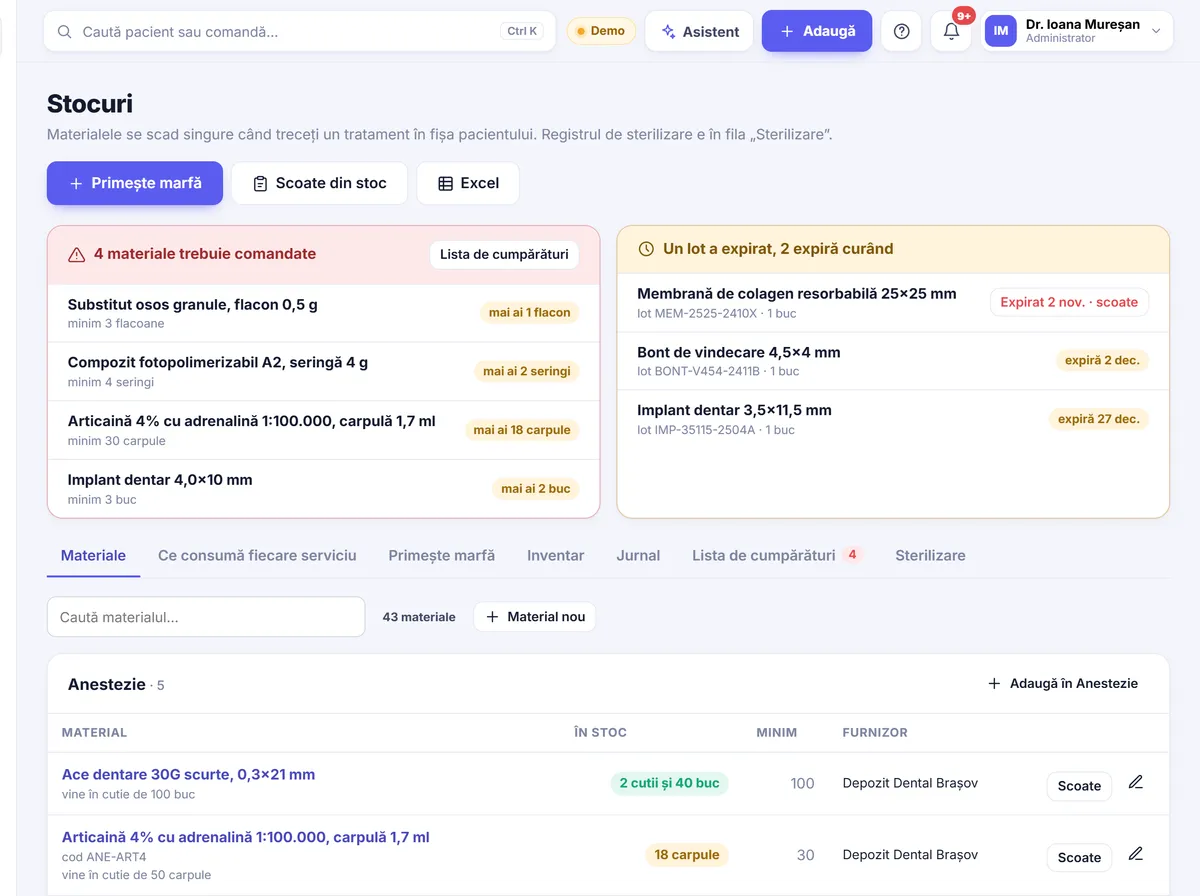
The routines above work on paper too. The hard part is keeping them up day after day when the diary is full. This is where a program that does part of the work for you helps. In Stomatik, the Stock module is designed specifically for dental practices.
Batches with expiry dates
Every incoming material is recorded by batch, with its expiry date. You can see at any time which batches you have and when each one expires, without opening the cupboards.
Automatic usage, from the batch that expires first
For each procedure you can set which materials it uses. When the treatment is recorded in the patient’s chart, the materials are automatically deducted from stock, from the batch that expires first. The FEFO rule applies itself, and the stock in the program stays close to what is on your shelves without anyone having to note down every cartridge.
Boxes and units
Materials are bought by the box but used by the unit. Stomatik keeps track in both, so when goods arrive you enter the boxes received, and usage is deducted by unit.
Barcode scanning with the camera
When goods arrive, the barcode on the packaging can be scanned with the camera of a phone or tablet, with no separate scanner. The program runs in the browser, on a computer, tablet or phone, so goods can be received right next to the parcel.
Shopping list
Your stock produces a shopping list, which you can print or export as CSV to send to the supplier. The person placing the order works from a clear list, not from a walk around the cupboards.
Because stock is linked to the treatments in the chart, the information comes from the practice’s daily activity. Permissions can be adjusted for each person in the team, so everyone sees and changes only what is theirs to handle.
How to get started, step by step
Whether you use a program or a notebook, the recommended order is the same:
- Do a full stock count, once, with batch numbers and expiry dates.
- Set the minimum stock for critical materials.
- Name one person responsible for receiving goods and one for orders (it can be the same person).
- Arrange materials by FEFO and keep to the rule with every delivery.
- Link usage to procedures, at least for the most used materials.
- Review the thresholds monthly: some will turn out too high, others too low.
If your patient and treatment data are still in another program, we can move them for you, free of charge; the details are on the switching from other programs page. And for plans, the pricing page shows what each one includes; the program’s features, including Stock, are the same in every plan.
See how batch-based stock and automatic usage look on a sample practice’s data, with no obligation.
Frequently asked questions
What does FEFO mean in a dental practice?
FEFO means the material that expires first is used first. It suits a dental practice better than first in, first out, because a new batch can sometimes have an earlier expiry date.
How do I set the minimum stock for a material?
Start from your usual weekly usage and how long the supplier takes to deliver, then add a margin. Review the threshold monthly, based on actual usage.
Why should I record batch numbers?
If a manufacturer recalls a batch, or you need to find out which material a patient received, batch records give you the answer quickly, without searching through cupboards.
Does Stomatik deduct materials from stock automatically?
Yes. You set which materials each procedure uses, and when the treatment is recorded in the chart, they are deducted automatically from the batch that expires first.
Do I need a barcode scanner?
Not necessarily. In Stomatik, the barcode on the packaging can be scanned with the camera of a phone or tablet.
Does the Stock module cost extra?
No. The program’s features are the same in every plan, and Stock is included in START too.