
Dental practice KPIs: which figures to review every month
Which figures are worth looking at once a month in a dental practice, what each one tells you about the practice and how to make the monthly report a habit.
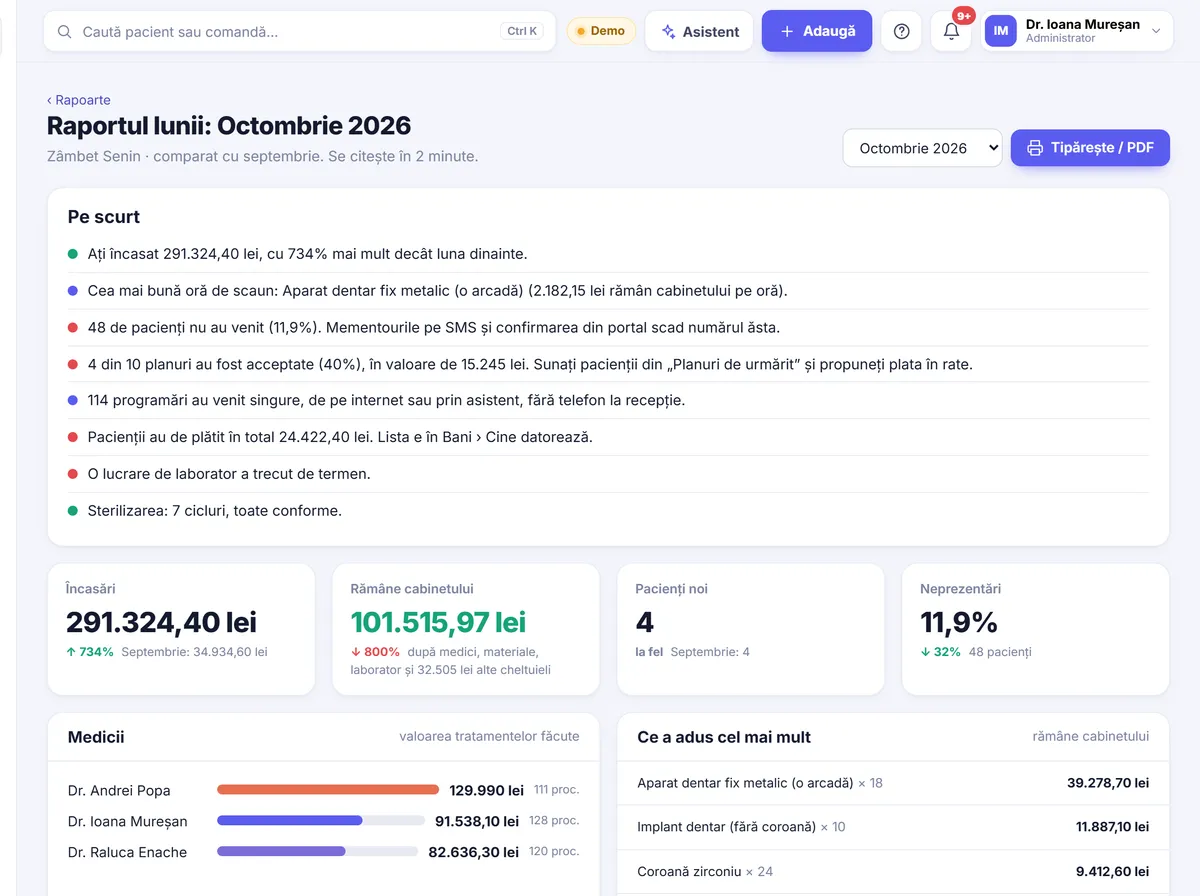
Many dentists who run a practice know very well how the clinical side is going, but less well how the practice is doing as a business. Not for lack of interest, but for lack of time: after a full day in the chair, the last thing anyone wants is to dig through spreadsheets.
The good news is that you do not need dozens of figures. A few indicators, looked at once a month with the same regularity, tell you almost everything you need to know. Below we go through them one by one, explained simply, with no made-up “ideal values”: every practice compares its figures first and foremost with its own previous months.
Why a monthly report and not a daily one
Figures vary a lot from one day to the next: a day with two large prosthetic cases looks excellent, a day with cancellations looks worrying. A month smooths out these differences and shows the real trend. And once a month is a pace anyone can keep up.
A practical tip: choose a fixed day, for example the first Monday of the month, and block out a free hour in your diary for the report. If there are several partners or you have a manager, look at it together.
Six figures to look at every month
The list below is not exhaustive, but it covers the questions practice owners usually ask themselves: how much money came in, where patients come from, how well time is used and what has been left unfinished.
1. Takings: per dentist and per payment method
The first figure everyone looks for is takings. The total is useful, but it only becomes truly informative when it is broken down:
- Per dentist. It shows how the work is spread across the team. A dentist whose takings are falling may have fewer hours in the diary, more new patients who have not yet accepted their plans, or simply a month of holiday.
- Per payment method. Cash, card, bank transfer, instalments. This matters for the till and for the accounts, but also to see whether patients use the methods you offer.
Compare each figure with the previous month and with the same month last year. A drop in August or January may simply be seasonal.
2. New patients and where they came from
How many new patients came this month? And, just as important: how did they hear about the practice? A recommendation from another patient, Google, the website, Facebook, walking past.
This figure answers a practical question: where is it worth investing time and money. If most new patients come from recommendations, it is worth looking after the experience of your existing ones. If a particular channel has brought in almost nobody for months, it may be worth rethinking.
The indicator only works if reception asks for and records the source for every new patient. Make it a rule.
3. Dentist and chair utilisation
Utilisation shows how much of the available time was actually spent with patients. It can be looked at per dentist (how much of their schedule was booked) and per chair (how long each chair was in use).
- Low utilisation may mean a lack of patients, a lot of cancellations, or hours that are too long for current demand.
- Very high utilisation, month after month, may mean patients wait too long for an appointment and it is time for another dentist or another chair.
4. Plans proposed and plans accepted
Many patients receive a treatment plan, say “I’ll think about it” and never come back. Not out of bad faith: they forget, put it off, or feel anxious about the cost. The gap between plans proposed and plans accepted is often a practice’s biggest reserve of work.
Each month it is worth asking: how many plans did we propose, how many were accepted, and which of the patients who did not reply should be called. We wrote about how to improve the chances of a plan being accepted in the article on the treatment plan accepted on the phone.
5. Outstanding balances
Work done in stages or paid in instalments inevitably leaves amounts still to be collected. Once a month, look at the list of patients with a balance outstanding: who owes what, for how long, and whether anyone has spoken to them. Old amounts are harder to recover than recent ones.
6. Recalls
Regular check-ups and hygiene visits keep patients close to the practice and prevent major problems. The simple indicator: how many patients were due to be recalled this month, and how many were actually contacted and booked in. If the Recalls list grows month after month, it means nobody has time to work through it and someone needs to be put in charge.
How to read the figures together
Each indicator tells you something, but the figures become truly useful when read together. A few examples of questions you can ask:
- Lots of new patients, takings flat? Perhaps the plans proposed to these patients have not been accepted yet. The Plans to follow up list is the place to look.
- High utilisation, low takings? Perhaps the diary is full of short visits or check-ups, while larger treatments are being put off. It is worth looking at which types of treatment fill the diary.
- Good takings, balances growing? The work is being done, but part of the money is not coming in. Perhaps you need a clearer rule for instalment payments.
There is no answer that fits every practice. The purpose of the monthly report is not to hand you verdicts, but to help you ask the right questions, in good time, and discuss them with your team.
What the monthly report looks like in Stomatik
All the figures above are only useful if they are easy to find. In Stomatik, Reports are built from the practice’s daily activity: the appointments, treatments and payments entered by the team.
The month’s report, written in sentences
Instead of a long table, Stomatik gives you the month’s report written in sentences that anyone can understand. You read it like a summary and only then go into the details if something catches your eye.
Takings, new patients and utilisation
- takings per dentist, per payment method and per location;
- new patients and where they came from;
- dentist and chair utilisation.
Plans to follow up and recalls
The Plans to follow up list shows you whom to call about the treatment plans you have proposed. For each service you can set after how many months the patient should be recalled, and the Recalls list shows who is next.
Export to Excel
Reports can be exported to Excel, for your accountant or for your own calculations. Stomatik also has accountant and manager roles, and permissions are adjusted for each person; details on the team and roles page.
And at the end of the month, each dentist has their commission statement, calculated on what has actually been paid.
In short
Takings per dentist and per payment method, new patients and their source, utilisation, accepted plans, balances and recalls: six things, one hour a month. You do not need more to know where your practice stands and what is worth changing. If you would like to see the month’s report on a demo practice’s data, book a presentation.
Get the month’s report written in sentences, straight from your practice’s day-to-day activity.
Frequently asked questions
Which KPIs should a dental practice track?
Takings per dentist and per payment method, new patients and their source, dentist and chair utilisation, plans proposed and accepted, outstanding balances and recalls.
How often should I look at my practice’s figures?
Once a month is a good pace: it smooths out day-to-day differences and is easy to keep up. Decisions are made on the trend over several months.
What should I compare my practice’s figures with?
First of all with previous months and with the same month last year. Every practice has its own rhythm and its own seasonality.
Can I export reports from Stomatik?
Yes, reports can be exported to Excel, for example for your accountant.
Can my accountant work in Stomatik too?
Stomatik has an accountant role, and permissions can be adjusted for each person in the team. Decide with us what each person needs to see.